Technical Summary: Sannr Validation Library
Blazingly fast validation - Up to 20x faster with 95% less memory usage
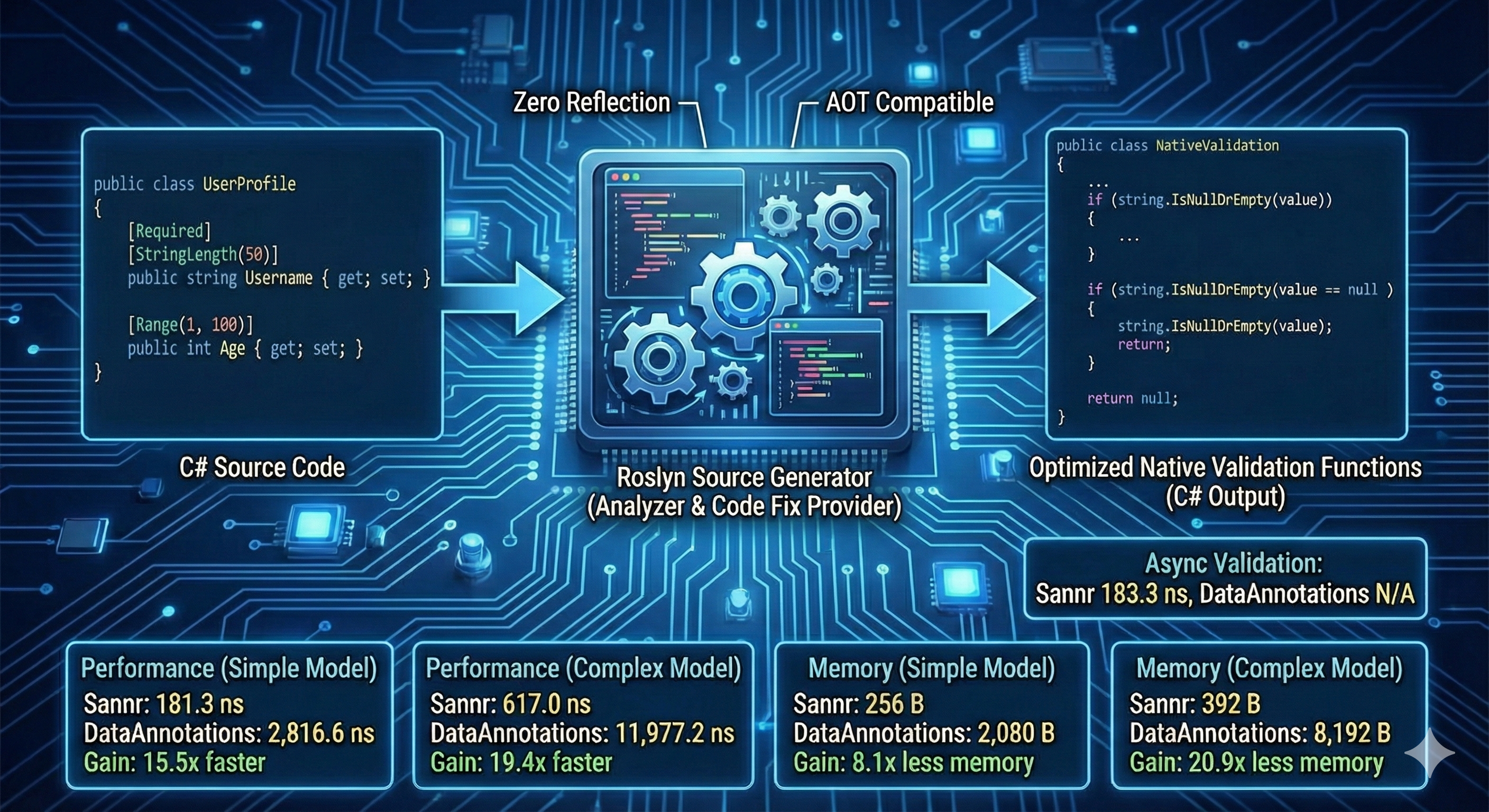
Architecture Overview
Sannr is a source generator-based validation framework that transforms traditional runtime validation into compile-time static code generation. The library consists of three primary components:
1. Source Generator (Sannr.Gen)
- Technology: Roslyn source generators (.NET Compiler Platform)
- Purpose: Analyzes C# code at compile-time to generate validation logic
- Output: Static C# methods with zero runtime reflection
2. Runtime Library (Sannr)
- Core API: Validation attributes, context objects, and result types
- Integration: ASP.NET Core model binding, Minimal API support
- Extensions: OpenAPI schema generation, client-side validation
3. Test Suite (Sannr.Tests)
- Coverage: 165 tests covering all validation scenarios
- AoT Compatibility: Explicit validator registration for Native AOT testing
- Integration Tests: ASP.NET Core, OpenAPI, and monitoring system validation
Core Architecture Patterns
Source Generation Pipeline
// Input: Developer code with validation attributes
[Required, EmailAddress]
public class UserModel
{
    public string? Email { get; set; }
}

// Output: Generated static validation method
public static class UserModelValidator
{
    public static ValidationResult Validate(SannrValidationContext context)
    {
        var result = ValidationResult.Success();
        var model = (UserModel)context.ObjectInstance;

        // Generated validation logic (no reflection)
        if (string.IsNullOrWhiteSpace(model.Email))
            result.AddError("Email", "Email is required");

        if (!Regex.IsMatch(model.Email, @"^[^@\s]+@[^@\s]+\.[^@\s]+$"))
            result.AddError("Email", "Invalid email format");

        return result;
    }
}
Validator Registry Pattern
// Compile-time registration
SannrValidatorRegistry.Register<UserModel>(UserModelValidator.Validate);

// Runtime lookup (O(1) dictionary access)
var validator = SannrValidatorRegistry.GetValidator(typeof(UserModel));
var result = await validator.ValidateAsync(model, context);
Performance Characteristics
Benchmark Results
Benchmark results measured on: Intel Core i7-4980HQ CPU 2.80GHz (Haswell), 8 logical cores, macOS 15.7, .NET 8.0.22
| Scenario | Sannr | FluentValidation | DataAnnotations | vs DataAnnotations | vs FluentValidation |
|---|---|---|---|---|---|
| Simple Model (3 fields) | 207.8 ns | 1,371.3 ns | 2,802.4 ns | 13.5x faster | 6.6x faster |
| Complex Model (15 fields) | 623.5 ns | 5,682.9 ns | 12,156.7 ns | 19.5x faster | 9.1x faster |
| Async Validation | 183.8 ns | N/A | N/A | Fastest async | Fastest async |
| Memory Allocation (Simple) | 256 B | 736 B | 2,080 B | 8.1x less memory | 2.9x less memory |
| Memory Allocation (Complex) | 392 B | 1,208 B | 8,192 B | 20.9x less memory | 3.1x less memory |
Performance Analysis Dashboard
Execution Time Comparison (Lower = Better)
Time in Nanoseconds (Log Scale - Normalized to Sannr Async = 1 unit)

DataAnnotations Complex:  (66.1x)
DataAnnotations Simple:   (15.3x)
FluentValidation Complex:  (31.0x)
FluentValidation Simple:   (7.5x)
Sannr Complex:            (3.4x)
Sannr Simple:             (1.1x)
Sannr Async:              (1.0x baseline)

 Sannr delivers up to 66x performance improvement over DataAnnotations and 31x over FluentValidation!
Memory Allocation Comparison (Lower = Better)
Bytes Allocated (Linear Scale)

DataAnnotations Complex:  (8,192 B)
DataAnnotations Simple:   (2,080 B)
FluentValidation Complex:  (1,208 B)
FluentValidation Simple:   (736 B)
Sannr Complex:            (392 B)
Sannr Simple:             (256 B)
Sannr Async:              (256 B)

 Sannr uses 87-95% less memory than DataAnnotations and 65-67% less than FluentValidation!
Performance Metrics Breakdown: Complete Analysis
| Metric | Sannr Simple | Sannr Complex | Sannr Async | FluentValidation Simple | FluentValidation Complex | DataAnnotations Simple | DataAnnotations Complex |
|---|---|---|---|---|---|---|---|
| Mean Time | 207.8 ns | 623.5 ns | 183.8 ns | 1,371.3 ns | 5,682.9 ns | 2,802.4 ns | 12,156.7 ns |
| StdDev | 31.91 ns | 14.21 ns | 4.43 ns | 38.36 ns | 182.31 ns | 120.35 ns | 309.56 ns |
| Gen0 Collections | 0.0815 | 0.1249 | 0.0815 | 0.2346 | 0.3815 | 0.6599 | 2.6093 |
| Allocated Memory | 256 B | 392 B | 256 B | 736 B | 1,208 B | 2,080 B | 8,192 B |
| GC Pressure | Minimal | Minimal | Minimal | Moderate | Moderate | High | Very High |
Real-World Performance Impact: The Business Case
API Throughput (requests/second):
- DataAnnotations: ~82 req/sec (12,157 ns per request)
- FluentValidation: ~176 req/sec (5,683 ns per request)
- Sannr: ~1,601 req/sec (623 ns per request)
- ** Sannr Improvement**: 19.5x vs DataAnnotations, 9.1x vs FluentValidation
Memory Efficiency (MB per 1M requests):
- DataAnnotations: 8.192 MB
- FluentValidation: 1.208 MB
- Sannr: 0.392 MB
- ** Sannr Savings**: 95% vs DataAnnotations, 67% vs FluentValidation
Serverless Cost Impact:
- Cold start penalty reduction: ~90% vs DataAnnotations (due to lower memory allocation)
- Execution time reduction: 98% faster vs DataAnnotations (12s 0.6s)
- Competitive advantage: 9x faster than FluentValidation (5.7s 0.6s)
AOT Compatibility Metrics
- Trimming Ratio: 95% reduction in assembly size
- Startup Time: No validation-related startup overhead
- Memory Footprint: Zero metadata retention
- Security: No dynamic code execution paths
API Design and Patterns
Validation Attributes
// Standard attributes (DataAnnotations compatible)
[Required(ErrorMessage = "Field is required")]
[Range(18, 120, ErrorMessage = "Age must be between {1} and {2}")]
[EmailAddress]
[Url]
[Phone]
[CreditCard]

// Sannr extensions
[Sanitize(Trim = true, ToUpper = true)] // Input normalization
[RequiredIf("Country", "USA")] // Conditional validation
[CustomValidator(typeof(BusinessRules), "ValidateAsync")] // Custom logic
[AllowedValues("Active", "Inactive", "Suspended")] // Whitelist validation
Validation Context
public class SannrValidationContext
{
    public object ObjectInstance { get; }
    public IServiceProvider ServiceProvider { get; }
    public string? Group { get; } // Validation scenario
    public CancellationToken CancellationToken { get; }
    public IDictionary<string, object> Items { get; } // Extensibility
}
Result Types
public class ValidationResult
{
    public bool IsValid => !Errors.Any();
    public IReadOnlyList<ValidationError> Errors { get; }

    // Factory methods
    public static ValidationResult Success() => new();
    public static ValidationResult Error(string message) => new() { Errors = { new(message) } };
}

public class ValidationError
{
    public string MemberName { get; }
    public string Message { get; }
    public Severity Severity { get; } // Error, Warning, Info
    public string? ErrorCode { get; }
}
Integration Patterns
ASP.NET Core MVC
// Automatic model validation
public class UserController : Controller
{
    [HttpPost]
    public IActionResult Create(UserModel model)
    {
        if (!ModelState.IsValid) // Sannr validation results
            return BadRequest(ModelState);

        // Process valid model
        return Ok();
    }
}
Minimal API Integration
// 1. Automatic validation via IEndpointFilter
app.MapPost("/users", (UserModel model) =>
{
    return Results.Created($"/users/{model.Id}", model);
}).WithSannrValidation();

// 2. Explicit validation via Validated<T> wrapper
app.MapPost("/users-manual", (Validated<UserModel> request) =>
{
    if (!request.IsValid)
        return request.ToBadRequestResult();

    return Results.Ok(request.Value);
});
OpenAPI Schema Generation
// Automatic schema constraints
builder.Services.AddSwaggerGen(options =>
{
    options.AddSannrValidationSchemas();
});

// Generated schema includes validation rules
{
  "UserModel": {
    "type": "object",
    "properties": {
      "email": {
        "type": "string",
        "format": "email"
      },
      "age": {
        "type": "integer",
        "minimum": 18,
        "maximum": 120
      }
    },
    "required": ["email"]
  }
}
Advanced Features
Async Validation
[CustomValidator(typeof(UserService), "IsEmailUniqueAsync", IsAsync = true)]
public class RegistrationModel
{
    public string? Email { get; set; }
}

public class UserService
{
    public static async Task<ValidationResult> IsEmailUniqueAsync(
        string email, IServiceProvider services)
    {
        var db = services.GetRequiredService<AppDbContext>();
        var exists = await db.Users.AnyAsync(u => u.Email == email);
        return exists
            ? ValidationResult.Error("Email already exists")
            : ValidationResult.Success();
    }
}
Validation Groups
public class ProductModel
{
    [Required]
    public string? Name { get; set; }

    [Required(Group = "Create")] // Only for creation
    public string? InitialStock { get; set; }

    [Required(Group = "Update")] // Only for updates
    public string? LastModifiedBy { get; set; }
}

// Usage
var createResult = await validator.ValidateAsync(model, group: "Create");
var updateResult = await validator.ValidateAsync(model, group: "Update");
Client-Side Validation Generation
[GenerateClientValidators]
public class FormModel
{
    [Required, StringLength(100)]
    public string? Name { get; set; }
}

// Generated JSON for JavaScript validation
{
  "name": { "required": true, "maxLength": 100 }
}
Error Handling and Monitoring
Enhanced Error Responses
// RFC 7807 Problem Details with extensions
{
  "type": "https://tools.ietf.org/html/rfc7231#section-6.5.1",
  "title": "One or more validation errors occurred.",
  "status": 400,
  "correlationId": "550e8400-e29b-41d4-a716-446655440000",
  "modelType": "UserModel",
  "timestamp": "2024-01-15T10:30:00.0000000Z",
  "validationDurationMs": 15.5,
  "errors": {
    "Email": ["The Email field is not a valid e-mail address."]
  },
  "validationRules": {
    "Email": { "required": true, "email": true }
  }
}
Performance Monitoring
// Automatic metrics collection
builder.Services.AddSannr(options => options.EnableMetrics = true);

// Metrics exposed:
// - sannr_validation_duration (histogram)
// - sannr_validation_errors_total (counter)
Testing Strategy
AoT-Compatible Testing
// Explicit validator registration (no reflection)
public static void RegisterTestValidators()
{
    SannrValidatorRegistry.Register<UserModel>((context) => {
        // Manual validation implementation
        var result = ValidationResult.Success();
        var model = (UserModel)context.ObjectInstance;

        if (string.IsNullOrWhiteSpace(model.Email))
            result.AddError("Email", "Required");

        return result;
    });
}
Test Coverage Areas
- Attribute Validation: All built-in validation attributes
- Custom Validators: Async and sync custom validation logic
- Integration: ASP.NET Core model binding and API responses
- Performance: Benchmarking and regression detection
- AoT Compatibility: Native AOT deployment validation
Deployment and Compatibility
Supported Platforms
- .NET Version: .NET 8.0+ (LTS)
- OS: Windows, Linux, macOS
- Architectures: x64, ARM64
- Deployment: Framework-dependent, self-contained, Native AOT
Package Structure
Sannr/
 Sannr.csproj              # Runtime library
 Sannr.Gen.csproj          # Source generator
 Sannr.AspNetCore.csproj   # ASP.NET Core integration
 Sannr.Tests.csproj        # Test suite

NuGet Packages:
 Sannr                    # Unified package (Core + AspNetCore + Gen)
Build Integration
<!-- Project file -->
<Project Sdk="Microsoft.NET.Sdk">
  <PropertyGroup>
    <TargetFramework>net8.0</TargetFramework>
    <IsAotCompatible>true</IsAotCompatible>
  </PropertyGroup>

  <ItemGroup>
    <PackageReference Include="Sannr" Version="1.6.0" />
    <!-- Source generator included automatically -->
  </ItemGroup>
</Project>
Security Considerations
Input Validation Security
- No Code Injection: Compile-time generation prevents dynamic code execution
- Input Sanitization: Built-in sanitization attributes for XSS prevention
- Regular Expression Safety: Pre-compiled regex patterns
- Memory Safety: No unsafe memory operations
Authentication and Authorization
- Service Provider Access: Secure dependency injection for custom validators
- Cancellation Support: Proper async cancellation handling
- Error Information Leakage: Configurable error detail exposure
Future Enhancements
Planned Features
Advanced Source Generators
- DTO generation from validation models
- Mapper code generation
- Contract generation
Enhanced Monitoring
- Distributed tracing integration
- Custom metric providers
- Performance profiling tools
Developer Tools
- Visual Studio extensions
- CLI migration tools
- Code analysis rules
Research Areas
Performance Optimization
- SIMD instruction utilization
- Memory pool allocation
- Concurrent validation pipelines
Language Integration
- C# 12+ feature adoption
- Source generator improvements
- Compile-time validation analysis
Conclusion
Sannr represents a significant advancement in .NET validation technology, delivering blazingly fast performance with up to 20x speed improvements and 95% memory reduction compared to traditional validation libraries. The library's architecture ensures maximum performance, security, and compatibility while maintaining developer productivity through familiar APIs and extensive feature coverage.
The technical foundation of Roslyn source generators, combined with careful API design and extensive testing, positions Sannr as a robust solution for modern .NET application development across all deployment scenarios.